
As part of an ongoing PFAS investigation, our team carried out eight EC-HPT soundings at a site in Gavere. The soundings reached depths of 19 to 25 m below ground level and aimed to characterise the subsurface at high resolution, enabling the study consultant to better substantiate PFAS mobility and sampling strategies.
Objective of the measurements
The EC-HPT data were intended to provide insight into:
- variations in permeability within the deeper subsurface profile;
- the transition from permeable to poorly permeable formations;
- intervals relevant for targeted PFAS sampling and monitoring.
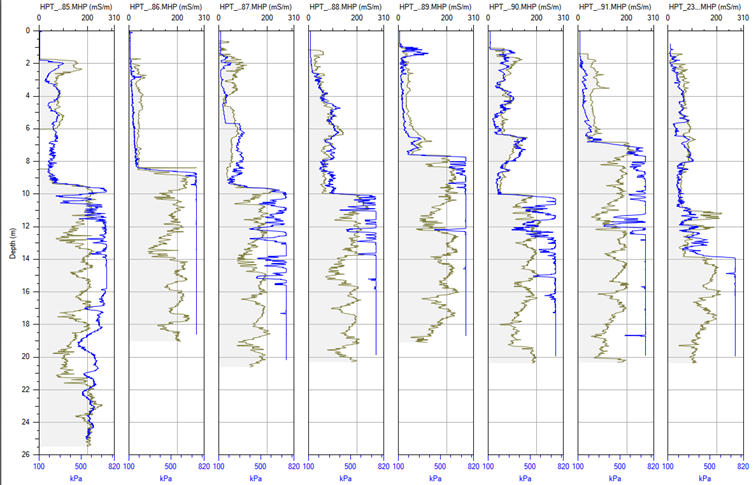
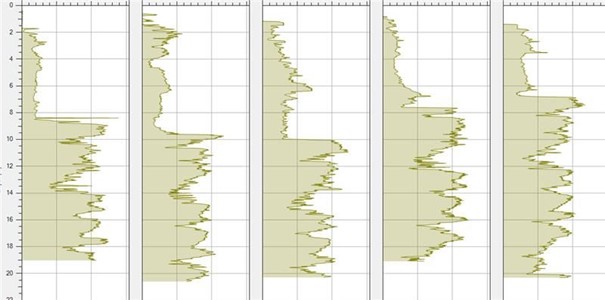
Observed stratigraphy and HPT response
The measurements clearly showed that the soundings captured the transition between:
- the Rozebeke Formation;
- the Kortrijk Formation
at depths of approximately 8 to 14 m below ground level.
Within this depth range, markedly increased HPT injection pressures were recorded alongside higher EC values. This response is consistent with the less permeable, clay-rich layers (possibly partially glauconitic) of the Kortrijk Formation.
Notably, intervals with reduced EC and HPT values were also identified within this formation. These zones are interpreted as thin, discontinuous silty lenses or fine sandy intercalations. Although limited in thickness and lateral continuity, such lenses can locally increase permeability and therefore create potential migration pathways.
Added value for PFAS investigations
The high-resolution data provided the study consultant with a much sharper understanding of the subsurface than would be achievable using conventional boreholes. The results support, among other aspects:
- Targeted selection of sampling intervals, aligned with permeable discontinuities;
- Improved positioning of temporary and permanent monitoring wells based on expected PFAS flux and migration behaviour;
- More realistic interpretation of groundwater concentrations through a clear link to stratigraphic variability.
Use of the data in the further study
The EC-HPT soundings form a robust basis for:
- integration into 2D and 3D subsurface models;
- insight into vertical and lateral variations in permeability;
- a well-founded evaluation of PFAS transport within a heterogeneous profile.
Through this high-resolution approach, the project team gains a technically sound understanding of the local stratigraphy and potentially relevant flow paths a critical prerequisite for accurate PFAS characterisation.